Trends · Cixur Team · October 31, 2026 · 6 min read
New Listings Radar: First Created Date Versus Renewal Date, and Why It Matters
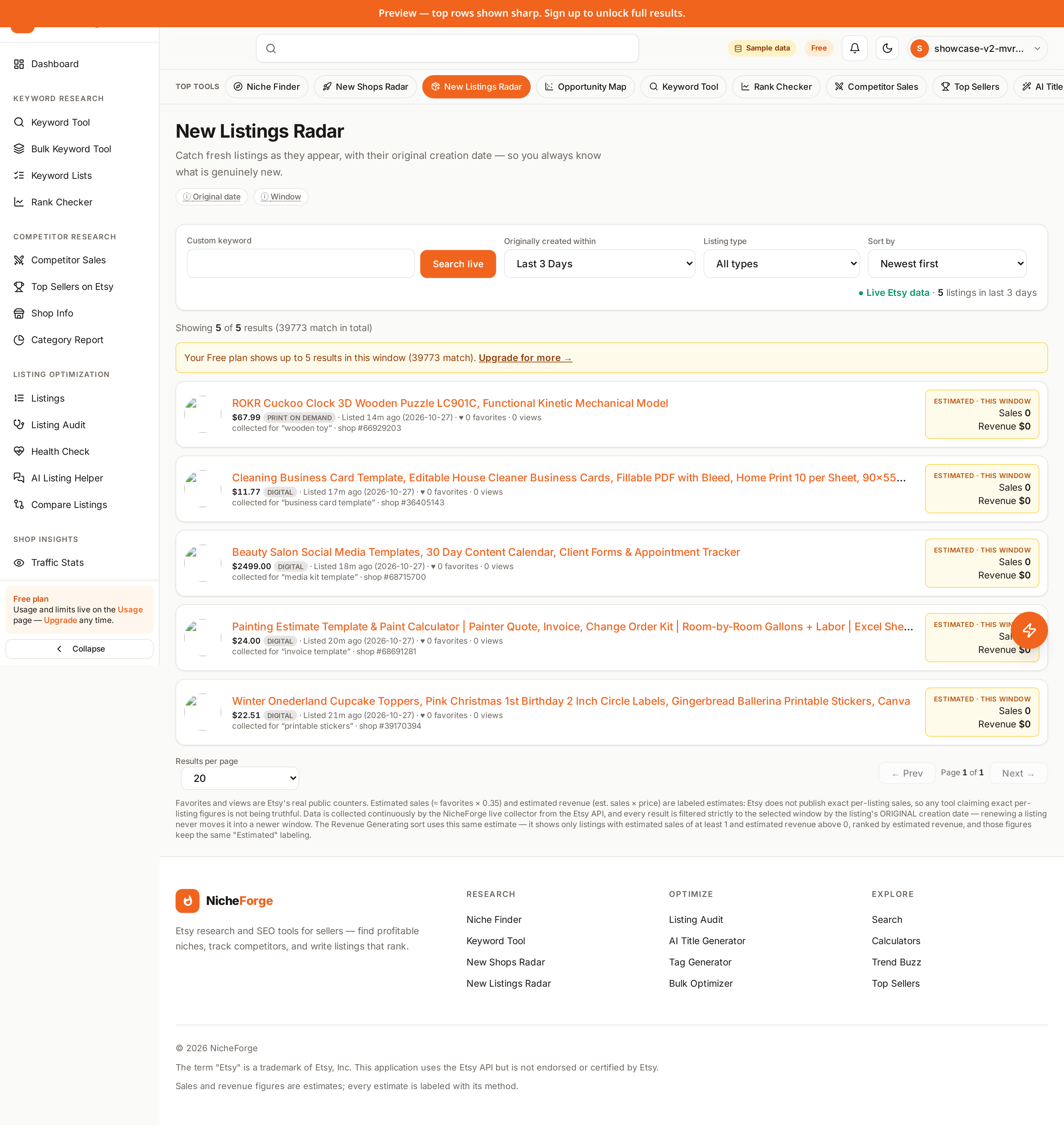
Every Etsy listing carries two dates, and confusing them is one of the most common research mistakes. The first is the date the listing was originally created. The second is the date shown after a renewal, because renewing a listing resets its displayed creation date to the renewal moment. A feed that sorts by the displayed date therefore mixes genuinely new listings with old listings that were simply renewed, and a seller who trusts that feed can chase yesterday's products while believing they are today's.
The New Listings Radar avoids that trap by placing listings by their first created date, not by renewals. This article explains the two dates, shows how renewal makes an old listing look new, and explains what first created date changes in practice when you research a niche.
Two dates every listing carries
Etsy records an original creation timestamp when a listing is first made. That timestamp is the listing's true birthday, and it never changes. Separately, the listing carries a creation timestamp that renews: each time a listing is renewed, whether by hand or automatically, that timestamp moves to the renewal moment. Both dates are real, but they answer different questions. One says when the product first appeared. The other says when it was last put back on the shelf.
Most casual browsing shows you the second date, because it is the one attached to the live listing. That is fine for shopping. For research it is a problem, because a listing created three years ago and renewed this morning wears today's date. If you sort by that date, the oldest, most renewed listings in a niche can crowd out the genuinely new ones.
How renewal makes an old listing look new
Renewal is a normal, legitimate part of selling: a listing that sells out or expires gets renewed so it can sell again. Nothing about renewal is deceptive. The distortion comes only from reading a renewed date as a creation date. A seller researching what is new this week from renewed dates will find a mix of true newcomers and veterans, and may conclude a niche is full of fresh ideas when it is actually full of familiar ones.
The effect grows with a niche's age. In an established niche, many strong listings have been renewed repeatedly, so a naive new today feed can be dominated by listings that are years old. In a young niche, the distortion is smaller, because fewer listings have had time to renew. The older the niche, the more first created date matters.
What first created date changes in practice
When you filter by first created date, the picture sharpens. What you see as new genuinely is new: products that did not exist in the niche before this window. That lets you answer the questions that matter: what themes are sellers trying for the first time, what price points are newcomers choosing, and which new products are gathering favorites quickly?
It also changes how you judge competition. A niche with many renewed listings but few first created listings is stable, even settled: the same products keep selling, and breaking in means outserving established listings. A niche with many first created listings is moving: new ideas keep arriving, and a newcomer has more room to be noticed. Both can be good niches, but they call for different strategies, and only the first created date lets you tell them apart.
A worked example
Imagine you open a naive listed today feed for a candle niche and see two listings at the top. The first is a citrus candle in a new amber jar, listed for the first time this week, with a handful of early favorites. The second is a lavender candle with hundreds of reviews, also dated today. Without first created date, they look equally new.
With it, the picture changes. The lavender candle was first created three years ago and renewed this morning; its reviews and favorites were earned over years, not days. The citrus candle is the true newcomer, and its early favorites are the interesting signal: buyers are responding to something genuinely fresh. Treating both as new would mislead you twice, by overstating the newcomer's competition and understating the veteran's head start.
How to use the radar window honestly
Pick a window that matches your question. A window of the last few hours shows what appeared since your last check. A 24 hour or 3 day window suits a daily or every few days routine. A 30 day window suits a monthly review of what is entering a niche. Paid plans extend the range to 90 days plus a custom range, and the Free plan covers 24 hours and 3 days. Filter by listing type too: digital, physical, or print on demand behave differently, and mixing them can hide the pattern in each.
Read the window as a sample, not a census. The radar shows listings the collector has seen in that window, and no feed can promise every listing on Etsy. Use it to spot themes and candidates, then validate each candidate with niche scores, buyer response, and margin before you commit. Freshness is a starting point for research, not a verdict on its own.
What freshness cannot tell you
A new listing is not necessarily a good listing, and a new theme is not necessarily a durable one. Some newcomers fail quickly because the price is wrong, the photos are weak, or the theme was a passing moment. Freshness tells you what is being tried. It does not tell you what will sell. That is why the radar belongs beside other tools: niche scores for demand and competition, keyword research for buyer language, and your own margin math for whether the idea can earn.
Frequently asked questions
What is the difference between first created date and renewal date?
First created date is the moment a listing was originally made, and it never changes. Renewal date is the moment a listing was last renewed, and it resets on every renewal. A listing can therefore show today's date while its idea is years old.
Does renewing a listing help it rank?
Renewal puts a listing back on the shelf so it can sell again, and a live listing can gather fresh activity. But renewal does not turn an old listing into a new idea, and research that treats renewed listings as newcomers will misread how crowded or fresh a niche really is. Judge a listing by its history, not its latest date alone.
Can I see the original creation date on Etsy itself?
Etsy does not prominently show a listing's original creation date to shoppers, which is why a radar built on first created date is useful: it recovers a distinction the ordinary listing page hides. Where a figure is an estimate, Cixur labels it Estimated with the method shown.
Why do radar windows matter?
A window defines what counts as new for your question. A short window shows what appeared since your last check, while a longer window shows the flow of ideas into a niche over weeks. Pick the shortest window that gives you enough listings to see a pattern, and widen it only when the list is too thin to judge.
Conclusion
Two dates, two stories. The renewed date tells you a listing is live now. The first created date tells you when its idea first entered the niche. For research, the second story is the one that matters, because it separates genuine newcomers from veterans wearing today's date. Use windows built on first created date, read them as samples, and validate before you act. Your research will be slower to excite you and far more reliable when it does.
Try it free: open the New Listings Radar and check what is genuinely new this week.
Get started free →The term "Etsy" is a trademark of Etsy, Inc. This application uses the Etsy API but is not endorsed or certified by Etsy.
More from News
- How to Find a Profitable Etsy Niche: A Beginner's Guide (Niche Research · 7 min)
- Etsy Keyword Research: Choosing Keywords That Match Buyers (Keyword Research · 6 min)
- Reading Demand vs Competition for an Etsy Niche (Niche Research · 6 min)
- Etsy Listing SEO Checklist: Titles, Tags, Descriptions (Listing SEO · 6 min)
- Spotting New Etsy Shops and Trends Early (Trends · 7 min)
- How to Use the Etsy New Shops Radar to Find Fresh Competition Early (Trends · 6 min)
- How to Read a Niche Score: Demand, Competition, and Opportunity Explained (Niche Research · 6 min)
- Etsy Keyword Research Without Official Search Volume: What Live Listings Can and Cannot Tell You (Keyword Research · 6 min)
- How to Do a Keyword Gap Check Against a Competitor Shop (Keyword Research · 6 min)