Keyword Research · Cixur Team · October 31, 2026 · 6 min read
Etsy Keyword Research Without Official Search Volume: What Live Listings Can and Cannot Tell You
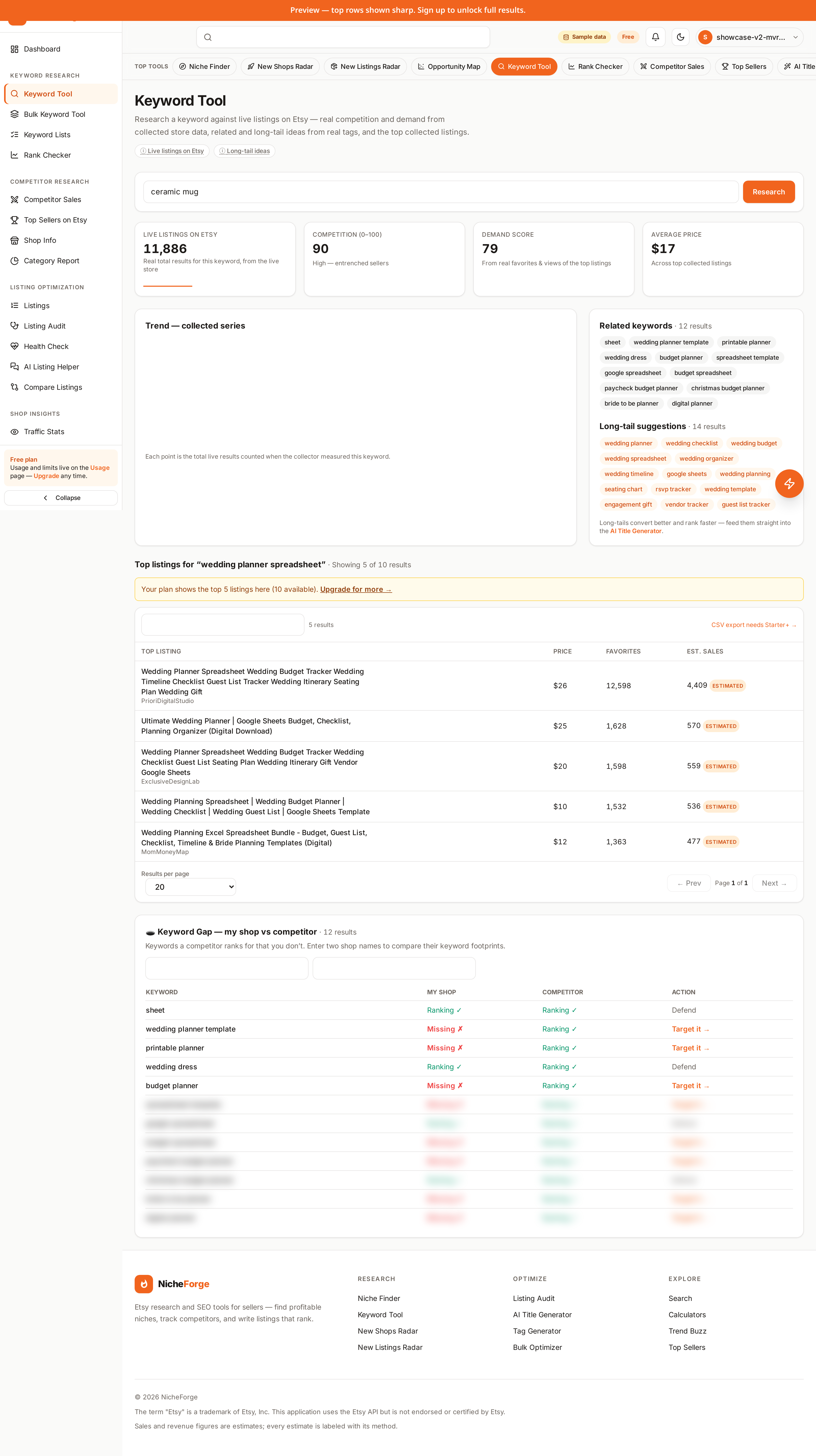
Sellers often ask for the search volume of an Etsy keyword, expecting a number like the ones other search engines publish. Here is the plain fact to start with: Etsy publishes no search volume figure. No tool can show you an official count of how many buyers searched a phrase on Etsy, because Etsy does not release one. Any number presented as official Etsy search volume is, at best, an estimate from another source, and should be labeled as such.
That does not leave you blind. Live listings carry rich evidence about a keyword: favorites, reviews, listing counts, tag frequency, and the pace of new listings. The Etsy Keyword Research Tool works from that evidence. This guide explains what live listings can tell you, what they cannot, and how to judge a keyword honestly without a volume number.
What live listings can tell you
Start with favorites. When listings targeting a phrase gather favorites steadily, buyers are responding to it. Reviews tell a similar story with harder evidence: a review means an order happened. Listing counts tell you how many sellers already target the phrase, and the pace of new listings tells you whether sellers keep betting on it. Tag frequency across a niche tells you which phrases sellers themselves use most, which is useful evidence about the language of the niche.
Together, these signals let you compare phrases. A phrase whose listings gather favorites and reviews, with steady new listings behind it, is showing real buyer pull. A phrase whose listings sit still, with few favorites and no new listings, is not. You are not measuring searches. You are measuring the visible response to listings that target the phrase, which is the closest honest proxy available.
What live listings cannot tell you
Live listings cannot tell you how many buyers typed a phrase and bought nothing, because that search left no listing trace. They cannot split buyers by intent: a phrase that brings browsers looks similar, at first, to one that brings purchasers. They cannot tell you what buyers will search next month, or whether a spike reflects durable interest or a passing moment. And they cannot tell you anything about a phrase with almost no listings, because there is too little evidence to read.
Be skeptical of any precise number offered for a phrase with thin evidence. A tool that reports an exact search count for a phrase nobody targets is dressing up a guess. Honest research says what it knows, says what it does not, and shows its method. Where a figure is an estimate, Cixur labels it Estimated with the method shown, so you can weigh it accordingly.
Judging a keyword without volume
Judge a candidate on three questions, in this order. First, relevance: does this phrase describe what you actually sell? Irrelevant traffic hurts you, because a click that does not convert tells search your listing was a poor match. Second, competition: how many listings target it, and how strong are they? Third, specificity: the more specific the phrase, the fewer rivals and the readier the buyer, even if the audience is smaller.
For a new shop, specific long tail phrases are usually the best starting point. A broad head term puts you against the whole marketplace. A specific phrase puts you against a handful of listings, in front of a buyer who knows what they want. As your shop gains favorites and reviews, you can reach for broader terms from a position of strength, with evidence behind you.
A practical workflow
Begin with a buyer sketch: who is buying, for whom, and for what occasion? Collect the phrases that buyer would type, in their words, not yours. Research each phrase against live listings, noting favorites, reviews, listing counts, and tag frequency. Sort the results into three groups: phrases to target now, phrases to watch, and phrases to drop because they are irrelevant or impossibly contested.
Place your chosen phrases where search can read them: the primary phrase near the start of the title, variations in tags, and the main keyword used naturally in the opening lines of the description. Then watch what happens. Which phrases bring views? Which bring favorites? Which bring sales? Change one thing at a time and let the response guide the next edit. Over months, this loop turns a rough list into a sharp one, without any volume number at all.
Numbers to treat with care
Treat every number in keyword research as a signal with a method, not as a fact. Favorites can be accidental. Reviews lag behind orders. Listing counts rise when sellers are excited, not only when buyers are buying. Estimated sales figures are estimates, labeled with their method, and they describe what listings appear to earn, not what any seller actually earned.
The discipline is simple: require more than one signal before you believe a story, prefer signals that involve buyer action over signals that involve seller activity, and distrust precision that the evidence cannot support. A phrase backed by favorites plus reviews plus steady new listings is a reasonable bet. A phrase backed by one flashy number is not.
Frequently asked questions
Does Etsy really publish no search volume figure?
Yes. Etsy does not release an official search volume number for keywords. Any figure presented as Etsy search volume comes from another source or model, not from Etsy itself, and should be labeled as an estimate with its method shown.
Why do some tools show a search volume number then?
Some tools estimate search interest from their own data, such as tracked listings, browser panels, or third party data, and present the result as a volume figure. Those estimates can be useful directionally, but they are not official Etsy data. Treat them as one signal among several, and ask what method produced them before you rely on them.
Is a favorites count the same as demand?
No, but it is related. Favorites show buyers responding to listings, which is evidence of interest. Demand also includes reviews, which reflect completed orders, and the pace of new listings, which reflects seller belief. Read favorites together with reviews and listing activity, not alone.
What should I do instead of chasing volume?
Judge phrases by relevance, competition, and specificity using live listing evidence, start with specific long tail phrases you can actually win, place them where search can read them, and refine from the views, favorites, and sales each phrase brings. That loop works without any volume number.
Conclusion
Etsy does not publish search volume, and honest research starts by saying so. What you have instead is better than nothing and, used carefully, enough: live listings showing how buyers respond, how sellers compete, and which phrases carry real language. Judge for relevance, competition, and specificity, lean on specific phrases early, and refine from real results. You do not need a volume number to be found. You need the buyer's words, honestly judged.
Try it free: research your first keyword against live listings today.
Get started free →The term "Etsy" is a trademark of Etsy, Inc. This application uses the Etsy API but is not endorsed or certified by Etsy.
More from News
- How to Find a Profitable Etsy Niche: A Beginner's Guide (Niche Research · 7 min)
- Etsy Keyword Research: Choosing Keywords That Match Buyers (Keyword Research · 6 min)
- Reading Demand vs Competition for an Etsy Niche (Niche Research · 6 min)
- Etsy Listing SEO Checklist: Titles, Tags, Descriptions (Listing SEO · 6 min)
- Spotting New Etsy Shops and Trends Early (Trends · 7 min)
- How to Use the Etsy New Shops Radar to Find Fresh Competition Early (Trends · 6 min)
- New Listings Radar: First Created Date Versus Renewal Date, and Why It Matters (Trends · 6 min)
- How to Read a Niche Score: Demand, Competition, and Opportunity Explained (Niche Research · 6 min)
- How to Do a Keyword Gap Check Against a Competitor Shop (Keyword Research · 6 min)