Keyword Research · Cixur Team · October 27, 2026 · 6 min read
Etsy Keyword Research: Choosing Keywords That Match Buyers
A buyer cannot buy a listing they never see. On Etsy, the bridge between a buyer and your listing is the search box — and the words they type there are your keywords. Many sellers treat keyword research as an afterthought, copying whatever words come to mind and hoping for the best. The sellers who get found treat it as a craft: they learn the exact phrases buyers use, judge which ones they can realistically compete for, and place those phrases where search can read them. This guide shows how, step by step, with no jargon and no guesswork.
Why keywords decide whether buyers find you
Etsy search matches listings to queries. When a buyer types a phrase, Etsy looks at titles, tags, and descriptions and ranks listings it judges most relevant. If your listing uses different words than the buyer, it may never appear — even if your product is exactly what they want. Keywords are therefore not decoration. They are the addressing system of your shop. Get them right, and the right buyers arrive. Get them wrong, and you are invisible to the very people who would love your work.
Think in buyer phrases, not product labels
Sellers describe products from the inside: materials, techniques, craft terms. Buyers search from the outside: occasions, recipients, problems, styles. A seller might think "hand-bound linen journal." A buyer types "wedding guest book" or "gift for writer friend." Both describe the same object, but only one matches the search box.
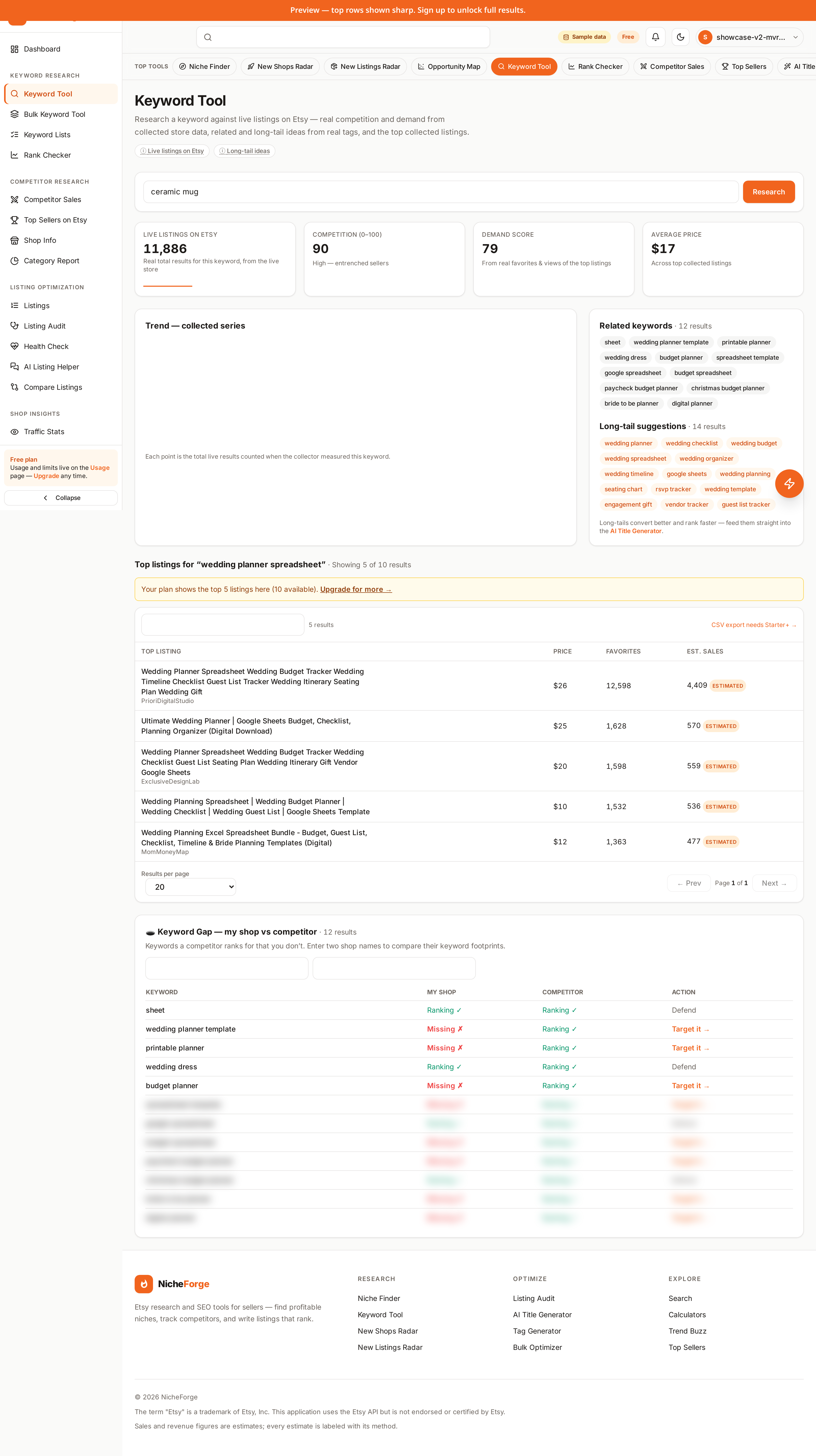
To find buyer phrases, start with the buyer sketch from your niche research. Who is buying, for whom, and for what occasion? Then look at real evidence: the titles and tags of listings that already sell in your niche, the words reviewers use when they describe what they bought, and the related terms surfaced by the Keyword Tool, which draws related and long-tail ideas from real listing tags. Collect phrases in the buyer's own words, not yours.
Build a keyword list from real listings
Open a set of strong listings in your niche and note the phrases they repeat. Repetition across many successful listings is a signal: those words are doing work. Also note the phrases that appear in only one or two listings — sometimes a fresh angle hides there. Sort your collection into three groups: head terms (short, broad, like "wall art"), mid-tail phrases ("boho nursery wall art"), and long-tail phrases ("watercolor rainbow nursery wall art printable"). You need all three, for different jobs, which the next sections explain.
Keep your list in one place — a saved list in the Keyword Tool or a simple document you revisit. A keyword list is a living asset. It grows as you learn, and it keeps your whole shop consistent: every new listing draws from the same researched language instead of starting from scratch.
Judge a keyword before you use it
Not every popular phrase is a good target. Judge each candidate on three questions. First, relevance: does this phrase describe what I actually sell, or would it bring buyers who bounce when they see my product? Irrelevant traffic hurts you, because a click that does not convert tells search your listing was a poor match. Second, competition: how many listings already target this phrase, and how strong are they? A short head term with many strong rivals is a hard climb for a new shop. Third, intent: is the searcher ready to buy, or just browsing for ideas? Phrases with words like "gift," a specific occasion, or a specific style usually signal stronger buying intent than vague browsing terms.
Score your candidates honestly. The strongest keywords for a new seller are usually relevant, specific, and moderately contested — not the biggest phrase in the niche, but the one you can actually win.
Long-tail phrases and why they matter
Long-tail keywords are longer, more specific phrases. They attract fewer searches each, but the buyers who type them know exactly what they want — and your listing, if it matches, is one of few good answers. For a new shop, long-tail phrases are the most reliable way to get found early. A broad term puts you against the whole marketplace. A specific phrase puts you against a handful of listings, in front of a buyer who is nearly ready to purchase.
Do not dismiss a phrase because it feels small. A shop built on many specific phrases, each bringing a steady trickle of ready buyers, grows on a solid base. As your shop gains favorites and reviews, you can reach for broader terms from a position of strength.
Placing keywords in titles, tags, and descriptions
Where you place a keyword matters. Put your primary phrase near the start of your title, where both search and human readers weigh it most. Use your tags to cover the phrases that did not fit in the title, including natural variations and long-tail forms — tags are how you reach the many ways buyers phrase the same need. In your description, use your main keyword naturally in the opening lines, then write for the human reader: answer their questions, describe materials and sizing, and explain shipping and care. Search reads descriptions too, but a description stuffed with repeated phrases reads poorly and converts poorly. One natural placement beats ten forced ones.
The AI Title Generator, AI Tag Generator, and AI Description Generator can draft these from your keyword and product details, with the character limits built in — but always read the draft as a buyer would before you publish. If it sounds like a person wrote it for another person, it is ready.
Common keyword mistakes
A few mistakes undo otherwise good research. Stuffing a title with repeated phrases wastes space and reads poorly to buyers. Targeting a phrase that describes a different product brings clicks that do not convert, which hurts ranking rather than helping it. Using only broad head terms leaves a new shop competing against the whole marketplace, while ignoring the specific phrases it could actually win. And setting keywords once and never revisiting them freezes your shop in place while buyer language moves on. Avoid these four, and your keyword work will keep paying off long after the first listing goes live.
Measuring what works and refining
Keyword research does not end at publishing. Watch which search terms bring views to each listing, and which listings earn favorites from those views. A phrase that brings views but no favorites may be mismatched to your product or photos. A phrase that brings favorites but no sales may need a price or description fix. Use the Rank Checker to see where a listing stands for a keyword over time, and re-check after you edit a title or tags — movement, in either direction, is feedback. Refine in small steps: change one thing, watch, then decide. Over months, this loop turns a rough keyword list into a sharp one.
Conclusion
Keyword research is simply listening to buyers before you speak to them. Learn their phrases from real listings, judge each phrase for relevance, competition, and intent, lean on specific long-tail phrases early, place your words where search can read them, and keep refining from real results. Do that consistently, and your listings stop hoping to be found — they start being found by the buyers they were made for.
Try it free — research your first keyword in the Keyword Tool today.
Get started free →The term "Etsy" is a trademark of Etsy, Inc. This application uses the Etsy API but is not endorsed or certified by Etsy.
More from News
- How to Find a Profitable Etsy Niche: A Beginner's Guide (Niche Research · 7 min)
- Reading Demand vs Competition for an Etsy Niche (Niche Research · 6 min)
- Etsy Listing SEO Checklist: Titles, Tags, Descriptions (Listing SEO · 6 min)
- Spotting New Etsy Shops and Trends Early (Trends · 7 min)