Listing SEO · Cixur Team · October 27, 2026 · 6 min read
Etsy Listing SEO Checklist: Titles, Tags, Descriptions
A listing can be beautiful, well-made, and fairly priced — and still sit unseen, because search cannot tell what it is. Etsy listing SEO is simply the work of making your listing legible: to search, so it appears for the right queries, and to buyers, so they trust it enough to purchase. This checklist covers the pieces that matter — titles, tags, descriptions, and the supporting signals sellers often forget — in an order you can follow for every listing you publish or revise.
How Etsy search reads your listing
When a buyer searches, Etsy weighs relevance and quality. Relevance comes mainly from your title, tags, and description: do your words match the query? Quality comes from how buyers respond: favorites, views, reviews, and completed orders. A listing that matches well and delights buyers climbs. A listing that matches poorly, or disappoints the buyers it attracts, sinks. SEO is therefore not a trick you apply once. It is the combination of accurate words and a listing that earns a good response. Keep that in mind as you work through the checklist: every item below serves either relevance or buyer trust, and the best listings serve both.
Titles: the first and strongest signal
Your title carries the most weight in search, and it is the first thing a buyer reads. Start with your primary keyword phrase — the exact phrase your buyer would type — near the beginning of the title. Follow it with the words that distinguish your product: style, material, size, occasion, recipient. Read the finished title aloud. If it sounds like a person describing the product to a friend, it is good. If it sounds like a string of keywords, rewrite it.
Avoid repeating the same word several times to chase relevance; repetition wastes space that could carry a distinct, useful phrase. Stay within the character limit, and spend your characters on words buyers use, not on filler. A title that is clear, specific, and natural beats a title that is long and stuffed, every time. Draft variants and compare them with the AI Title Generator, then pick the one that reads most naturally.
Tags: cover the many ways buyers phrase one need
Tags are your chance to cover the many phrasings of a single need. If your title says "boho nursery wall art," your tags can carry "rainbow nursery decor," "baby room wall hanging," "neutral nursery art," and the other ways buyers express the same desire. Use all the tag slots available to you, with multi-word phrases rather than single words where possible — a phrase matches a buyer's query more precisely than a lone word.
Draw tags from real buyer language: the tags of strong listings in your niche, the words reviewers use, and the related terms from the Keyword Tool. Keep each tag within the character limit, and keep a few backup phrases ready for the day you revise. The AI Tag Generator produces a full set plus backups from real listing language, with a live character counter on every tag.
Descriptions: written for humans, readable by search
Your description has two readers: the buyer deciding whether to trust you, and search checking relevance. Write for the buyer first. Open with your main keyword in the opening lines, naturally, as part of a sentence a person would write. Then answer the questions a buyer asks before purchasing: what is it made of, what size is it, how is it personalized, how long does it take, how is it shipped, how do I care for it? Add a short questions section for the queries you hear most, and close with a gentle invitation, not pressure.
Structure helps both readers. Short paragraphs, clear sections, and plain language beat a wall of text. Mention variations and options a buyer might want — different sizes, colors, or personalization — because those words also help search match you to more specific queries. Draft the full structure with the AI Description Generator, then edit it in your own voice before publishing.
Photos, price, and the signals sellers forget
SEO is not only words. Your first photo is the listing's handshake: bright, clear, showing the product in use or in context, with no clutter competing for attention. Additional photos should answer buyer questions — scale, detail, packaging, personalization options. Price matters too: a price far above comparable listings needs a visible reason — premium materials, personalization, a bundle — or buyers will pass. Shipping clarity matters: state processing time and shipping honestly, and keep them consistent with what you actually do. Renewals, favorites, and reviews all feed the quality side of ranking, so the unglamorous work — shipping on time, answering messages, resolving problems gracefully — is SEO work as well.
The order to fix things in
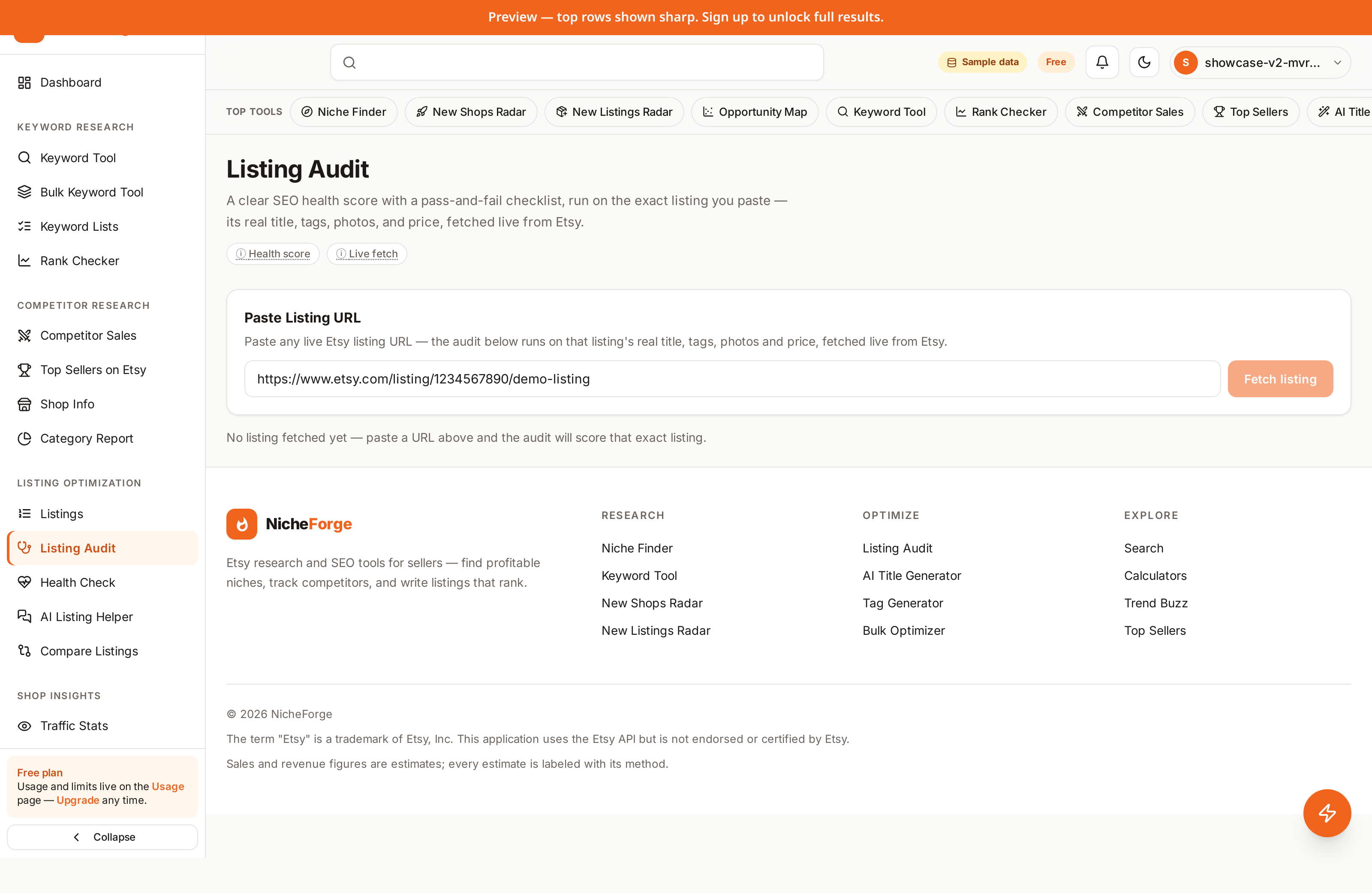
When a listing underperforms, fix in this order. First, relevance: is the title's primary phrase what buyers actually type, and do the tags cover their variations? Run the Listing Audit to score the listing against a checklist and see what fails first. Second, clarity: do the photos and description answer a buyer's questions at a glance? Third, offer: is the price fair for what is shown, and is shipping clear? Fourth, reach: are there related phrases in the Keyword Tool you have not yet covered? Fixing in this order keeps you from polishing photos on a listing that search cannot even find.
Revising an old listing without breaking what works
Revising a listing that already earns favorites needs care. Change one element at a time, and keep a note of what you changed and when, so you can connect any movement in views or favorites to the right edit. Protect what is already working: if a listing ranks for a phrase that brings buyers, keep that phrase in the title while you improve the rest. Refresh photos before rewriting copy when the listing's problem is trust rather than relevance — a buyer who cannot see the product clearly will not read further, no matter how good the description is. And give each change time to show its effect before judging it. Search responds over days and weeks, not minutes, and impatient sellers often undo a good edit before it has had a chance to work.
After publishing: measure and refine
SEO does not end at publishing. Watch which search terms bring views, which listings earn favorites, and where a listing ranks for its main keyword with the Rank Checker. Change one thing at a time — a title phrase, a tag swap, a first photo — and watch what moves before changing the next. Small, measured changes, tracked over weeks, compound into listings that hold strong positions. The sellers who treat SEO as an ongoing habit, not a one-time task, are the ones whose listings keep getting found.
Conclusion
Good Etsy SEO is not complicated. It is a clear title led by the buyer's phrase, tags that cover the many ways buyers ask for one thing, a description that answers real questions, photos that build trust, and a price that makes sense. Work the checklist in order, measure what changes, and refine steadily. Your listings will not just rank better — they will deserve to.
Try it free — audit your first listing with the Listing Audit today.
Get started free →The term "Etsy" is a trademark of Etsy, Inc. This application uses the Etsy API but is not endorsed or certified by Etsy.
More from News
- How to Find a Profitable Etsy Niche: A Beginner's Guide (Niche Research · 7 min)
- Etsy Keyword Research: Choosing Keywords That Match Buyers (Keyword Research · 6 min)
- Reading Demand vs Competition for an Etsy Niche (Niche Research · 6 min)
- Spotting New Etsy Shops and Trends Early (Trends · 7 min)