Niche Research · Cixur Team · October 27, 2026 · 6 min read
Reading Demand vs Competition for an Etsy Niche
Ask a seller why a shop struggles and you will often hear one of two stories: "nobody wanted it" or "everyone was already selling it." Both stories describe the same mistake — entering a niche without reading its two central forces, demand and competition, together. Demand without competition sounds wonderful and usually means demand is absent too. Competition without demand is a crowded room with no customers. The skill that separates steady sellers from frustrated ones is learning to read both forces side by side, honestly, before committing time and money. This guide teaches that reading.
Two forces, one decision
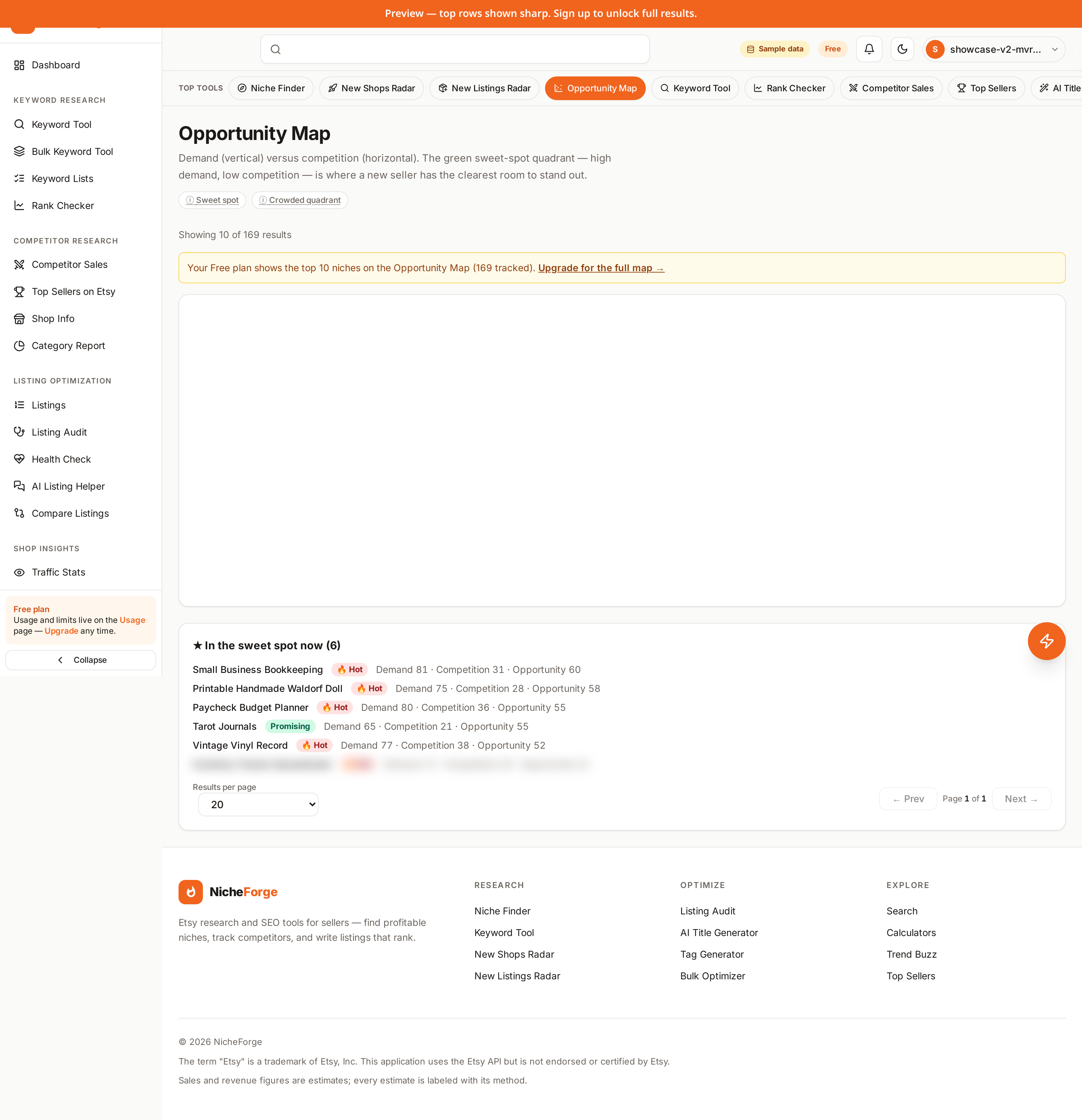
Think of demand as the pull of buyers toward a niche, and competition as the push of sellers already serving it. Your opportunity lives in the gap between them: enough pull to bring buyers, not so much push that a newcomer cannot be seen. Neither force alone tells you anything useful. High demand with fierce competition can still be a fine business if you bring a distinct angle. Modest demand with almost no competition can be a fine business if your costs are low and your buyers are loyal. The decision is always about the pair, never about one number in isolation. The Opportunity Map plots niches exactly this way — demand against competition — so you can see the gap at a glance.
What real demand looks like
Real demand leaves traces. Listings in the niche gather favorites over time, not just in a launch burst. Shops collect reviews steadily, which means orders are actually happening. New listings keep appearing, because sellers keep betting on the niche. Search interest clusters around occasions, seasons, or problems that recur — weddings, new babies, holidays, home moves — rather than a single fleeting moment.
Read demand over time, not in a snapshot. A niche that spikes for a week around a holiday and then goes quiet is seasonal, not dead — it simply needs a launch calendar, which the Trends views and the seasonality planner help you build. A niche that fades month after month, with fewer favorites and fewer new listings, is losing its pull. A niche whose favorites and reviews hold steady while new sellers keep arriving is showing durable demand, the kind a new shop can build on.
What real competition looks like
Competition is more than a listing count. Count listings, yes, but then look closer. How strong are the leading shops? Do they have deep review histories, polished photos, and many sales behind them? Or are the top spots held by listings with thin photos and vague titles that a careful newcomer could outshine? How similar are the listings to each other? A niche where every listing looks alike is a niche crying out for a distinct angle — different style, different size range, different personalization, different bundle.
Also notice concentration: if a handful of shops dominate the first pages, breaking in takes longer. If attention is spread across many smaller shops, a newcomer has more room. The Top Sellers view and the Category Report help you see both the leaders and the shape of the whole field, not just a single page of results.
Putting the two together: four situations
Picture four corners. High demand, low competition is the sweet spot everyone wants — and the rarest, because sellers rush toward it. If you find one, move promptly but still test small. High demand, high competition is the crowded market: enter only with a clear angle that the leaders do not serve, and expect a longer climb. Low demand, low competition is the quiet corner: it can work beautifully for a seller with low costs and a loyal, specific audience, but it will not support a large shop on its own. Low demand, high competition is the trap — many sellers chasing few buyers. Walk away, no matter how much you like the product. Naming which corner you are in, before you list, prevents most expensive mistakes.
The signals that mislead sellers
Several signals look like demand but are not. A flood of new listings can mean sellers are excited, not buyers. A viral social media moment can create a spike that vanishes before your listings are ready. A single shop's success can reflect that shop's audience or marketing, not the niche itself. And a high listing count with weak traction everywhere usually means the niche is saturated with hope rather than orders. Guard against these by requiring more than one kind of evidence: favorites plus reviews plus steady new listings, not any one signal alone. Where a figure is an estimate — for example Estimated sales — read the method shown beside it and treat it as an estimate, not a fact.
Pricing and margin as a third check
Demand and competition answer "can I be seen and wanted?" Pricing answers "can I earn?" A niche can pass both demand and competition checks and still fail here: if the going price leaves no margin after fees, materials, and shipping, it is not a business for you. Sketch the money side early, with realistic costs, and run it through the Calculators. If the margin only works at a price the market will not bear, the honest answer is to pick a different niche or a different product within the niche — a bundle, a personalized version, a premium material — that justifies a higher price.
Re-checking a niche you are already in
Reading demand and competition is not only for choosing a niche. It is also for staying in one wisely. Re-check your niche on a regular rhythm: are favorites and reviews holding steady, are new listings still appearing, are the leaders getting stronger or is attention spreading? If your niche is cooling, you will see it in these signals before it shows in your own sales, and you can respond early — refresh listings, adjust your angle, or start a second line in an adjacent niche while the first still earns. If your niche is heating up, the same check tells you to defend your position: improve photos, sharpen titles, and add the variations buyers are asking for. A niche is a living market, not a decision you make once.
When to enter, wait, or walk away
Enter when demand is durable, competition has gaps you can serve, and the margin works at a price buyers accept. Wait when demand is seasonal and the peak is far off — use the waiting time to prepare listings, photos, and tags so you launch before the peak, not during it. Walk away when demand is fading, when competition is dense with no gap you can credibly fill, or when the margin fails at every realistic price. Walking away is not failure. It is the discipline that keeps your time and money for the niche that deserves them.
Conclusion
Demand and competition are not mysterious forces. They are visible in favorites, reviews, listing counts, leader strength, and pricing — if you read them together and over time, and if you demand more than one signal before you believe a story. Make this reading a habit for every niche you consider, and your shop decisions will get calmer, clearer, and more often right.
Try it free — plot your niche ideas on the Opportunity Map today.
Get started free →The term "Etsy" is a trademark of Etsy, Inc. This application uses the Etsy API but is not endorsed or certified by Etsy.
More from News
- How to Find a Profitable Etsy Niche: A Beginner's Guide (Niche Research · 7 min)
- Etsy Keyword Research: Choosing Keywords That Match Buyers (Keyword Research · 6 min)
- Etsy Listing SEO Checklist: Titles, Tags, Descriptions (Listing SEO · 6 min)
- Spotting New Etsy Shops and Trends Early (Trends · 7 min)